
Quick answer
How does mobile home removal work and what does it cost?
Removal means the home leaves intact: permits cleared, utilities cut, axles under it, towed away. Market averages run about $4,000 for a single-wide moved under 50 miles and around $7,000 for a double-wide. Homes too far gone to tow get demolished instead — and homes with real value get a buyout offer, not a bill.
Removal, demolition, or a check — the honest decision tree
Every unwanted mobile home lands in one of three buckets, and the right bucket is a math problem, not a sales pitch. A home built after 1980 that is dry, square, and structurally sound can be resold or relocated — that is a home we may pay you for. A home that can survive a tow but has no market left gets removed and salvaged. A home that is soft in the floors, burned, or rotten gets demolished on site and hauled out as sorted debris. The worst outcome is paying whole-home prices for a home that should have been handled a cheaper way — several Carolina counties charge flat per-unit disposal rates that make tear-down-first the obviously better call, which is exactly the kind of county-by-county arithmetic we publish on our disposal fee pages.
What the law actually requires before a home moves
Both states put a tax gate between you and the road. In North Carolina, G.S. 105-316.1 makes it unlawful for anyone but a manufacturer or dealer to remove a mobile home from a property without a county tax permit, displayed on the rear of the home for the whole trip. The permit costs nothing — but the tax collector will not issue it until every tax owed on the home is settled, and the statute backs that up with Class 3 misdemeanor penalties and the authority to detain the home mid-move. In South Carolina, S.C. Code 31-17-360 requires the county licensing agent to see a treasurer's certificate of zero unpaid taxes before issuing a moving permit, and a home crossing the county line needs the current year paid in full. Highway movement rides on separate oversize transport permits. We sequence all of it — tax office, licensing agent, transport — before a truck ever shows up.
What a removal costs
| Scenario | Published range | Notes |
|---|---|---|
| Single-wide, moved under 50 miles | about $4,000 | US Mobile Home Pros market average |
| Double-wide, moved under 50 miles | about $7,000 | moves in halves |
| Transport leg to a landfill | $1,000 to $2,000 | Hometown Demolition; disposal fees added |
| Full deconstruction | up to $10,000 | hand-sorted salvage, the slow option |
Ranges from published national cost guides (Hometown Demolition, US Mobile Home Pros); your quote is built from your county's actual fee schedule, linked on every county page.
How the job runs
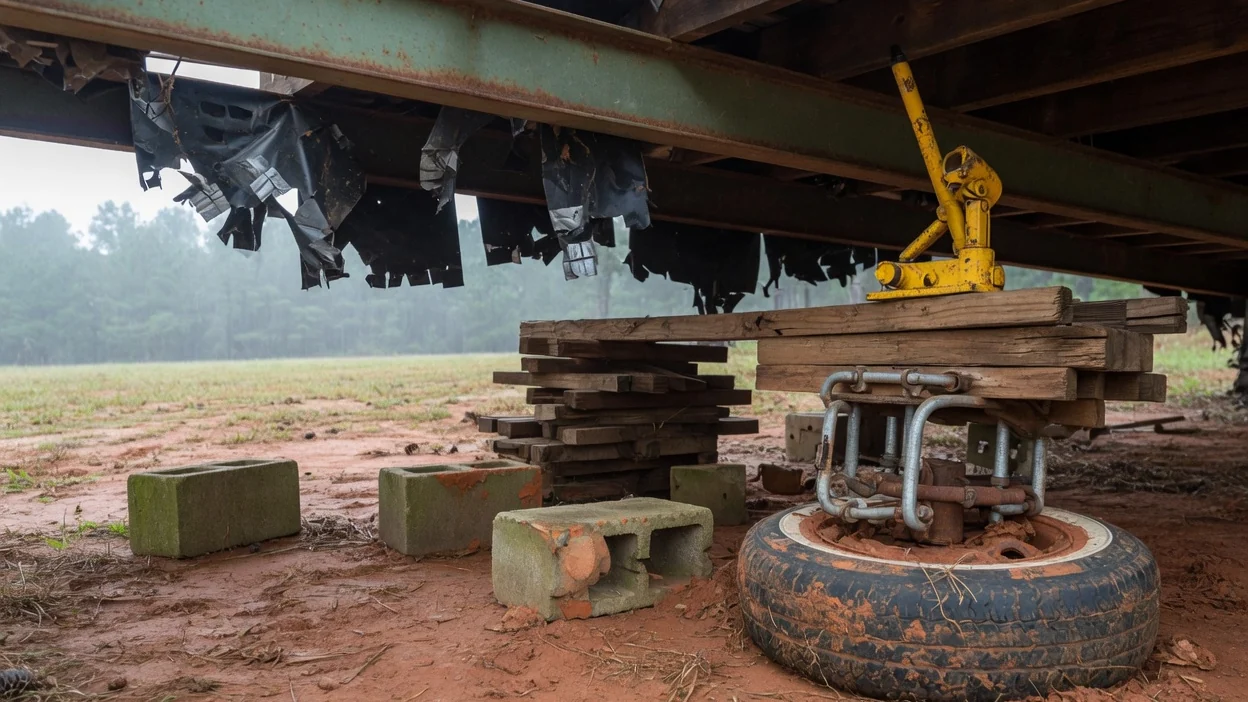
A removal is mostly preparation. Utilities get verified dead at the pole and the tank, not assumed dead. Skirting, steps, decks, and porches come off. Anchors and tie-down straps are cut, the home is raised, axles and tires go under, and the hitch goes on. A double-wide is split at the marriage line and buttoned up for weather. Then the toter takes it — permit on the rear, per statute — and what is left behind is a set of piers and whatever the years piled around the home, which we clear before we call it done. Most single-wide removals are a one-day site job once permits are in hand.
FAQ
Questions we actually get
How much does mobile home removal cost?
Do I need a permit to have a mobile home removed in North Carolina?
What about South Carolina?
Can a mobile home be removed in one piece?
Is free mobile home removal real?
What happens to the home after removal?
Next step
That home is not going to remove itself
Every month it sits, it costs lot rent, taxes, or land you cannot use. Get a firm number today.
Get My Free Quote Call (828) 501-2670